I definitely will be trying this out. I think it is important for me to have as much data and tools online and not on my drive. It makes me feel secure to know that if my computer crashes, I can easily get to my data and not worry that it is lost. My fiancee and I share lots of documents, and to have Google's docs locally and online, makes it easier to edit updates at any point in time (online/offline).
Monday, March 31, 2008


Erik Natzke's Processing Art
I'm really digging Processing. I bought my self a how-to book today from Amazon. Check out Erik Natzke's ill designs using Processing.


Processing is an open source programming language and environment for people who want to program images, animation, and interactions. It is used by students, artists, designers, researchers, and hobbyists for learning, prototyping, and production. It is created to teach fundamentals of computer programming within a visual context and to serve as a software sketchbook and professional production tool. Processing is developed by artists and designers as an alternative to proprietary software tools in the same domain.
Processing is an open source programming language and environment for people who want to program images, animation, and interactions. It is used by students, artists, designers, researchers, and hobbyists for learning, prototyping, and production. It is created to teach fundamentals of computer programming within a visual context and to serve as a software sketchbook and professional production tool. Processing is developed by artists and designers as an alternative to proprietary software tools in the same domain.
Dr Romanelli and his dope Converse kicks

Really dope kicks by Dr. Romanelli. The sales of its partners' ( (PRODUCT) RED ) products has generated over $50 million so far for the Global Fund. The details of this sneaker is just amazing. All leather, with bandaid embossing. The tongue has one of my favorite colors, chocolate brown. The inside has a diagram of a humans head, as well as the bottom has a clear gel and a graphic of a humans skull.
Workaholics need coffee breaks
Spice up your colleagues' day with our Newton Virus, the first virus to introduce gravity to your laptop, causing the desktop icons to fall down as if subject to the gravitational pull from the real world.
Newton Virus comes on a USB key for manual infection. Simply plug the key into a computer and the virus will automatically copy itself on the hard drive.
Newton Virus comes on a USB key for manual infection. Simply plug the key into a computer and the virus will automatically copy itself on the hard drive.
Friday, March 28, 2008
How to calculate the closest distant object

I am not a huge math geek, but I do like to come up with solutions. I feel as though I am moving closer to the programming world and less on the Graphic Design realm. Which is fine by me, I can focus my creativity to illustrations and paintings on my spare time. Understand, that I am no means a programmer at his pureness. I am learning every step of the way.
What I do like about blogging, is the journal entry aspect. This is where I can write things up that I have discovered. I am most happy to share what I learn with anyone else who chooses to have interest.
Now, with that disclaimer out there. If I had a focused object and many other objects surrounding that focused object; How could I find the closest object to that focused object? So I was proposed this question a couple of weeks ago.
I immediately thought of the Pathagreom Theorem (a(Square) + b(square) = c(square)). I said to my self, I understand of the problem. If I were to get the distance of all the objects x and y positions and subject them by the x and y position of the focused object, I could get the distances of each one to the focus object. I could than get the distance between an object and a main object by simply using ActionScripts Math.sqrt() function by passing in the distances x and y positions.
Okay, so if I am able to get the distances between each object and the focused object; I would than have to store the coordinates some where for checking, later. I stored each result distance into an array. After I stored all my distances, I then sorted the array valued numbers in numeric order by using the sort() function built-in ActionScript. If I were to trace out the distances array on it’s first array, I would get the closest number to the main object. This is really cool and all, but how can I really utilize this, one would say.
var distances:Array = [];

var objRef:Array = [];


for ( var i:int = 0; i < number =" this[" number =" this[" number =" Math.round(Math.sqrt(">


I looked further into this, and asked myself a question. How can I find the nearest object to the main object. So added a few more lines of code. I first added a new array, this is so I can keep track of my distance and object references. Than in my original for loop I stored my objects references into the new array. Each object reference is placed into a datatype Object. This is all done for reference checking later.


Now, after I have my numeric values sorted in order; I now create another for loop. This simple loop will go through each object reference and check if the closest distance matches the object referenced distance. If this is correct, we can now do what ever we please with that object.


var distances:Array = [];

var objRef:Array = [];

var num:int = 3;


for ( var i:int = 0; i < number =" this[" number =" this[" number =" Math.round(Math.sqrt(" int =" 0;">
Thursday, March 27, 2008
Photoshop Express

After a year in the making, Finally Photoshop has an online tool. I'm so excited to dig and play with this. Photoshop Express was entirely built with Flex - How exciting is that!?
Wednesday, March 26, 2008
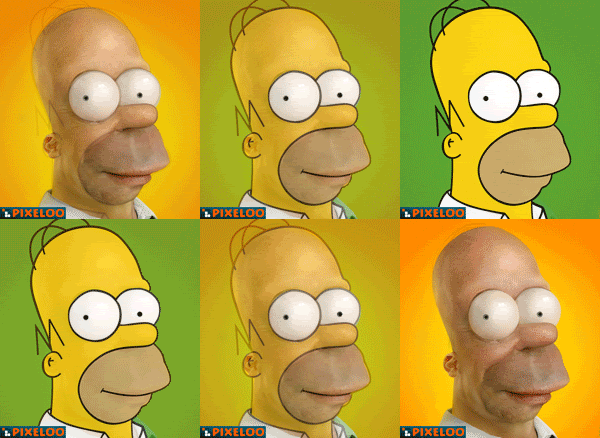
Homer is human
 A colleage sent me this. It was designed by an anonymous blogger. I tried looking up the designer but he has a very vague description on who he is. I guess, if he really didn't want attention, he wouldn't leave water marks. The dude also has an animated image of how he did it.
Subscribe to:
Posts (Atom)